
BEEOS CLOUD / DEVELOPER REFERENCE
Data channels
Connect messaging, ACP, terminal, canvas, files, and viewers through scoped descriptors
Cloud management, product-user events, and live data use different paths. The product backend authorizes the user, calls the Server SDK for business commands, and publishes product-visible events on its own user real-time channel. For a live data channel, it issues or obtains a short-lived, purpose-scoped descriptor; the frontend then connects to the named endpoint.
| Channel | Intended use | Entry point | Integration |
|---|---|---|---|
| Product user events | Chat status, notifications, and product-facing updates | Product backend's authenticated user real-time channel | Subscribe using the product session and ACL |
| ACP | Agent protocol stream | Backend-authorized ACP descriptor | Connect using the returned transport and scope |
| Terminal | Interactive shell | Backend-authorized terminal descriptor | Connect using the returned transport and scope |
| Canvas / A2UI | Structured agent UI | Agent canvas.token; backend-authorized Canvas descriptor | Render authorized UI state |
| Yjs | Shared document state | Canvas collaboration transport | Authorize document access |
| WebRTC viewer | Remote device video and input | Backend-authorized viewer descriptor | Exchange signaling and media |
| Files | Presigned transfer | Server files.prepareUpload; Agent files.presign | Transfer bytes to storage URL |
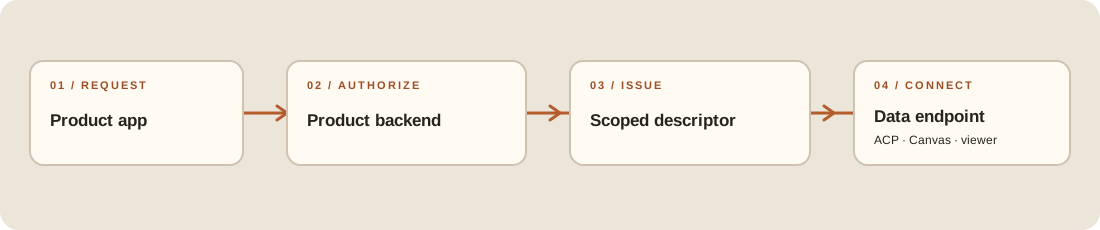 Open the diagram at full size
Do not treat a descriptor as the live connection or as a command API. The frontend uses WebSocket, WebRTC, Yjs, or another declared transport only for the authorized purpose. Check expiration and request a fresh descriptor through the backend when needed. Business CRUD and agent commands travel through the backend and Server SDK; observing a stream is not authority to perform those commands. Never place a bsk_ key in browser or mobile code.
For terminal and ACP integration, use the transport and scope returned by the environment instead of assuming a fixed URL or protocol. Product frontend integration describes the backend boundary; UI and deployment architecture explains A2UI and A2HTML.